
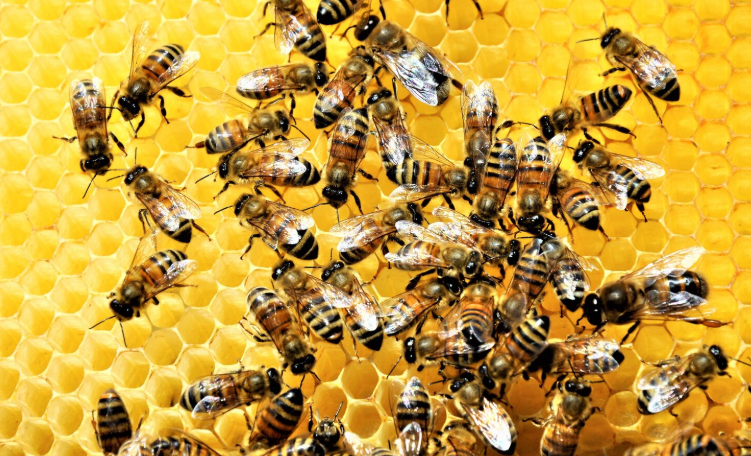
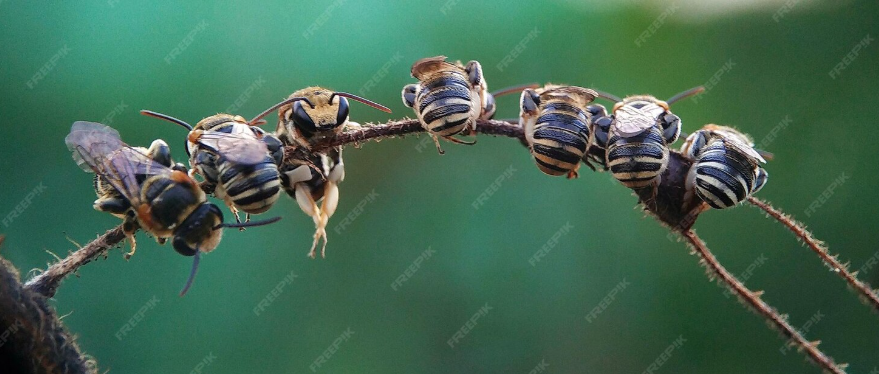
Honey bees are small but extraordinary creatures that play one of the most important roles in nature. These tiny insects are responsible for pollinating thousands of plant species, helping flowers turn into fruits, vegetables, and seeds. Without honey bees, much of the food we depend on—such as apples, berries, cucumbers, almonds, and sunflowers—would become scarce. Their partnership with plants has evolved over millions of years, making them essential to both ecosystems and human survival.
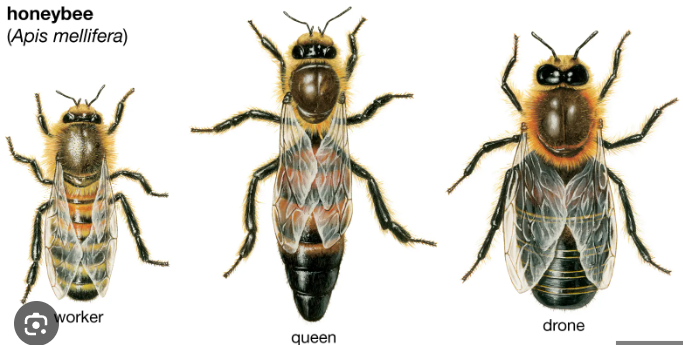
A honey bee colony is a highly organized society made up of a queen, workers, and drones. The queen lays eggs and ensures the colony’s future, worker bees maintain the hive and gather food, while drones mate with the queen to maintain genetic diversity. Every bee has a purpose, and together they form a super-efficient system based on teamwork and communication. One of the most fascinating behaviors of honey bees is their waggle dance, a coded movement used to share information about food sources, distance, and direction—even inside the dark hive.
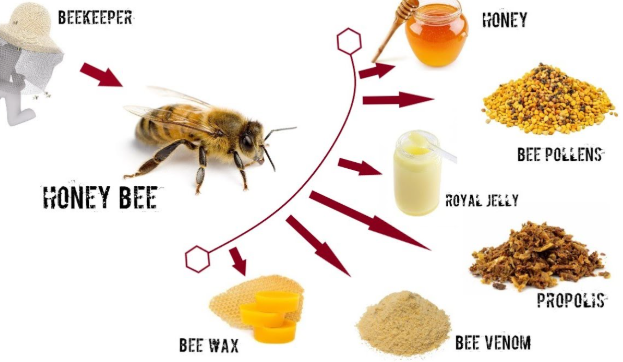
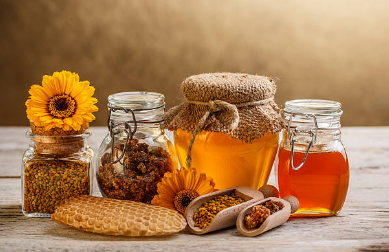
Honey bees also produce valuable substances such as honey, beeswax, royal jelly, propolis, and pollen, all of which have been used by humans for nutrition, medicine, skincare, and wellness for thousands of years. But despite their importance, honey bees are facing threats from pesticides, habitat loss, climate change, and diseases. Their decline is a warning sign for the environment and global food security.
Understanding honey bees—their life cycle, behavior, and ecological value—is essential for appreciating their contribution to the world and taking steps to protect them for future generations.
Etymology and Name
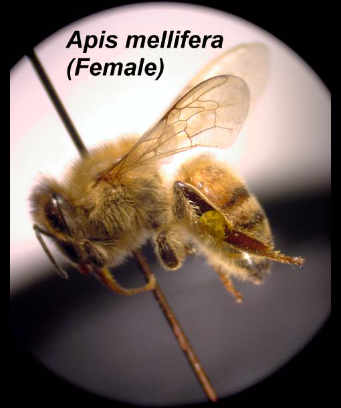
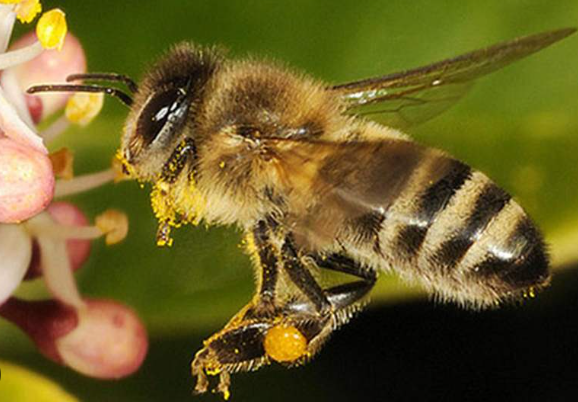
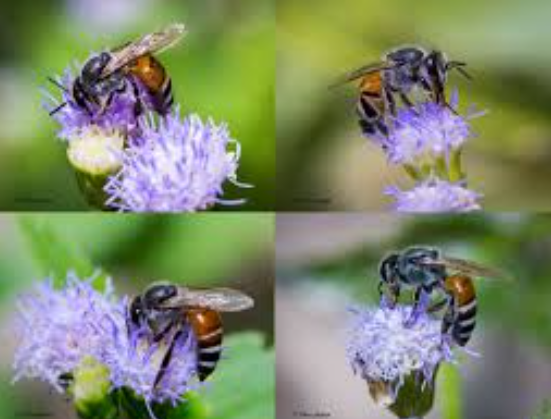
The term “honey bee” refers to insects belonging to the genus Apis, a Latin word that simply means “bee.” The English term honey bee emerged from Old English “hunig beo”, literally meaning “the bee that makes honey.” This distinguishes them from other types of bees such as carpenter bees, stingless bees, damselflies, or bumblebees.
Historically, honey bees have been known by many cultural names:
Greek: (melissa), meaning “honey bearer.”
Sanskrit: (madhumakshika), meaning “honey fly.”
Ancient Egyptian: Symbol of royalty and rebirth.
Arabic: (nahlah), meaning “the giver” or “the one that labors.”
Across civilizations, honey bees have been associated with hard work, productivity, purity, and sweetness. They are considered sacred in Vedic culture, divine in Greek mythology, and symbolic of life in Egyptian beliefs. The name itself carries the essence of service, nature, and creation.
Origin, Systematics, and Distribution
1. Origin and Evolution
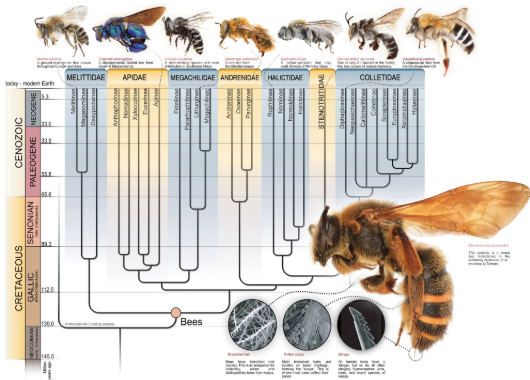
Honey bees are ancient insects whose evolutionary roots trace back over 100–130 million years, emerging alongside early flowering plants (angiosperms). Their evolution is closely linked to the spread of flowering plants; as flowers evolved new colors, shapes, and nectar sources, bees evolved specialized tongues, hairs, and behaviors to interact with them.
Scientific evidence suggests:
Honey bees may have evolved from ancient sphecid wasps.
Fossil evidence from the Cretaceous period shows bees structurally similar to modern species.
Their evolution accelerated as flowers diversified globally.
This co-evolution between bees and flowers is one of nature’s most successful partnerships.
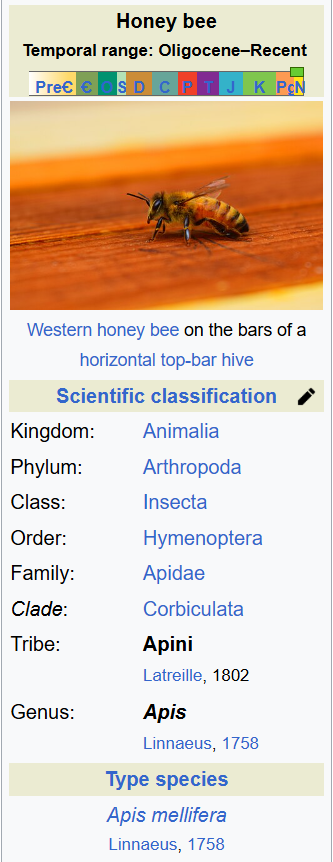
2 Systematics (Classification)
Honey bees belong to:
Kingdom: Animalia
Phylum: Arthropoda
Class: Insecta
Order: Hymenoptera
Family: Apidae
Tribe: Apini
Genus: Apis
The genus Apis consists of several well-studied species that produce honey and build complex wax combs.
Major Species of Honey Bees (Apis Genus):
Apis mellifera – Western/European honey bee
Apis cerana – Asian/Indian honey bee
Apis dorsata – Giant honey bee
Apis florea – Little honey bee
Apis koschevnikovi – Bornean honey bee
Apis nigrocincta – Sulawesi honey bee
Apis andreniformis – Black dwarf honey bee
Each species has unique behaviors, hive structures, foraging distances, and honey yield.
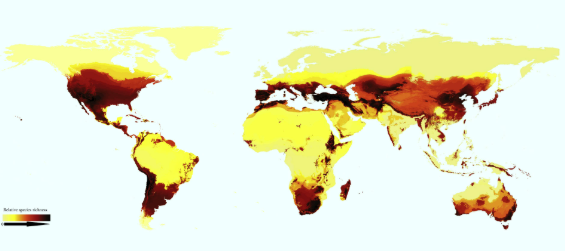
3. Distribution of Honey Bees
Honey bees are naturally distributed across:
Asia
Africa
Europe
Middle East
Through human introduction, they now inhabit:
North America
South America
Australia
New Zealand
Honey bees thrive in:
Tropical forests
Grasslands
Agricultural farmlands
Temperate regions
Even desert margins
They are found everywhere except Antarctica, mainly because extreme cold prevents flowering plants from growing—and bees cannot survive long without flowers.
4. Expansion Through Human Agriculture
With the development of agriculture:
Farmers realized bees increased crop productivity.
Humans began transporting bees worldwide in wooden boxes.
Apis mellifera was introduced into America in the 1600s.
Modern beekeeping created global honey trade, pollination services, and commercial bee farms.
Today, honey bees play a direct role in:
Global food supply
Fruit agriculture
Vegetable farming
Nut production
Seed farming
Their distribution is now deeply tied to human civilization.
5. Ecological Niches and Environmental Adaptations
Honey bees adapt to different environments through:
⭐ Behavioral Adaptations:
Different foraging times
Temperature-based hive cooling and heating
Colony migration during scarcity
⭐ Physical Adaptations:
Long proboscis for nectar extraction
Barbed sting for hive defense
Pollen baskets (corbiculae) for pollen transport
⭐ Social Adaptations:
Division of labor
Communication dances
Thermoregulation through collective fanning
These traits allow them to survive in diverse climates ranging from the Himalayan foothills to African savannas.
6. Genetic Diversity and Hybrid Bees
Selective breeding and natural hybridization created unique bee sub-species:
Italian honey bee – Gentle, productive
Carniolan bee – Good winter survival
Africanized bee (Hybrid) – Very defensive, highly productive
Africanized bees (also called “killer bees”) are a controversial hybrid created unintentionally in Brazil but now spread widely. They are aggressive but excellent producers and pollinators.
7. Fossil Evidence and Ancient Records
Fossil records show:
The oldest known bee fossil dates to 100 million years preserved in amber.
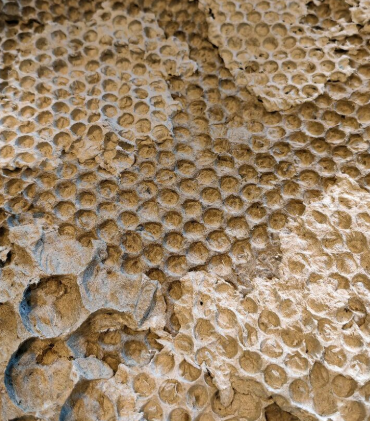
Fossilized honeycombs appear in Miocene rocks (20 million years old).
Ancient cave paintings in Spain (8000 years old) show humans harvesting honey.
Honey bees have been part of Earth’s ecosystem since dinosaurs roamed the planet.
Their long-term survival and stability make them one of nature’s greatest evolutionary successes.
Living and Fossil Honey Bees (Apini: Apis)
Honey bees belong to the tribe Apini, within the genus Apis, a group of highly evolved insects known for producing honey, building sophisticated wax combs, and living in complex social colonies. The structure, diversity, and fossil records of the genus Apis provide a remarkable glimpse into how these bees have transformed through millions of years.
🌿 1. Overview of the Genus Apis
The genus Apis contains all true honey-producing bees. These species are unique because:
They build vertical wax combs with perfect hexagonal cells.
They maintain stable colony temperatures through fanning and clustering.
They communicate through the famous “waggle dance.”
They have a rigid social hierarchy: queen, workers, and drones.
They produce honey not only for immediate use but also for long-term storage.
Apis bees are among the most successful social insects on Earth, rivaled only by ants and termites.
🌿 2. Living Honey Bee Species (Modern Apis Species)
Modern honey bees consist of nine recognized species, each with unique traits, behaviors, and evolutionary adaptations. They can be broadly divided into three groups:
A. Dwarf Honey Bees
(Small-sized, open-nesting species)
1. Apis florea (The Little Honey Bee)
Found in: India, Middle East, Southeast Asia
Nest style: Single exposed comb on tree branches
Size: Very small
Honey yield: Low
Behavior: Peaceful, non-aggressive
This species is important for pollination but not ideal for commercial honey production.
2. Apis andreniformis (Black Dwarf Honey Bee)
Darker in color
Found mainly in Southeast Asia
Produces small amounts of medicinal honey
B. Giant Honey Bees
(Large species with huge colonies)
1. Apis dorsata (Giant Honey Bee)
Found in: India, Sri Lanka, Nepal, Indonesia
Comb size: Very large, often over a meter wide
Nesting: Open, on cliffs or tall trees
Behavior: Extremely defensive
Honey yield: Good, but difficult to harvest
These bees migrate long distances and form dense clusters on rocky cliffs for protection.
2. Apis laboriosa (Himalayan Giant Honey Bee)
Largest honey bee species in the world
Lives at 2500–3000 meters altitude
Produces red honey, known for medicinal and psychoactive properties
Harvesting involves dangerous cliff climbing (Nepal’s “Honey Hunters” tradition)
C. Cavity-Nesting Domestic Honey Bees
(Build combs inside enclosed spaces)
1. Apis cerana (Asian/Indian Honey Bee)
Native to India and Asia
Calm and manageable
Honey yield: Moderate
Natural resistance to pests (like Varroa mites)
Performs well in tropical regions
Widely used in India for small-scale beekeeping.
2. Apis mellifera (Western/European Honey Bee)
Most widespread honey bee species globally
Used in commercial honey production
Calm and highly productive
Very strong colony hierarchy
Adaptable to a wide range of climates
This species has more than 30 sub-species or races.
Important Subspecies of Apis mellifera
⭐ Italian Bee (Apis mellifera ligustica)
Golden color
Gentle behavior
High honey yield
Most popular among beekeepers
⭐ Carniolan Bee (Apis mellifera carnica)
Excellent winter survival
Fast spring development
Very calm temperament
⭐ Africanized Bee (Hybrid)
Created unintentionally in Brazil (1956)
Tough, heat-resistant
Highly defensive
Strong pollinator & high honey yield
Often called “Killer Bees,” but essential to some ecosystems.
🌿 3. Fossil Honey Bees – Ancient Species of Apini
The fossil record reveals ancient species of honey bees from millions of years ago. These fossils help scientists track how bees evolved from solitary ancestors to social honey-makers.
🦋 A. Cretaceous Period Fossils (100–120 Million Years Old)
The earliest bee-like fossils are from amber deposits. They show:
Body hair for pollen collection
Long tongues for flower nectar
Wing structures similar to modern bees
These ancient bees prove that honey bee ancestors co-evolved with flowering plants (angiosperms).
🦋 B. Miocene Period Fossils (15–25 Million Years Old)
This period provides the clearest fossil evidence of honey bees.
Two major fossil species include:
1. Apis lithohermaea
Largest honey bee fossil discovered
Believed to be closely related to today’s giant honey bees
Shows similarities in wing venation and abdomen patterns
2. Apis henshawi
Found in Europe
Indicates early expansion of Apis species across continents
Exhibits advanced social traits similar to modern bees
🌿 4. Fossil Honeycomb Evidence
Not just bee bodies—fossilized honeycombs have also been discovered.
Features include:
Perfect hexagonal patterns
Wax-like structures preserved in mineral form
Evidence of colony-based living
Indications of early “thermoregulation” behavior
These honeycombs reveal that bees were social long before humans appeared on Earth.
🌿 5. Ancient Honey Discoveries
⭐ Egypt (3,000 years old)
Archaeologists found pots of honey in Egyptian tombs, still preserved and edible due to honey’s natural antibacterial properties.
⭐ Spain (8,000-year-old cave painting)
Cueva de la Araña cave shows humans climbing cliffs to harvest honey from giant bees.
⭐ Greece & India
Ancient texts like Ayurveda and Greek medical writings describe honey in healing.
These findings confirm honey bees’ long-standing importance to human civilization.
🌿 6. Comparison: Ancient vs. Modern Honey Bees
| Feature | Ancient Bees | Modern Bees |
|---|---|---|
| Size | Some were larger | Mostly smaller except Apis dorsata |
| Nesting | Mostly open-nesting | Both open + cavity nesting |
| Honey Production | Limited | Advanced honey storage |
| Social Behavior | Early stages | Highly complex |
| Distribution | Restricted | Worldwide |
The evolution of honey bees made them more efficient, intelligent, and cooperative over time.
🌿 7. Importance of Studying Fossil Bees
Studying ancient bees helps scientists understand:
Climate change impacts
Evolution of flowering plants
Social behavior development
Bee disease history
Ecological roles through time
Fossils reveal that bees have survived multiple mass extinctions—yet today, modern threats like pesticides and habitat loss endanger them more than ever.
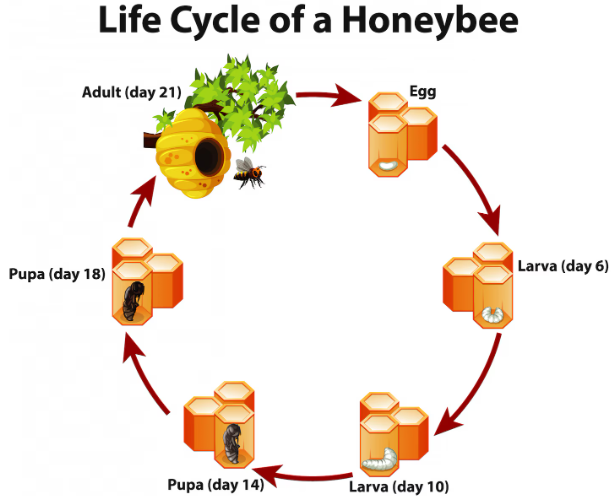
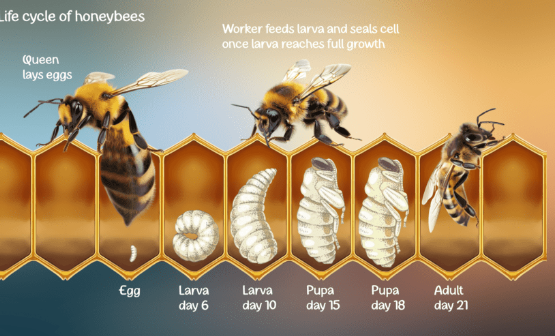
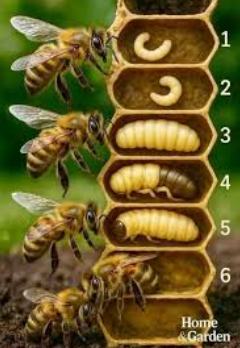
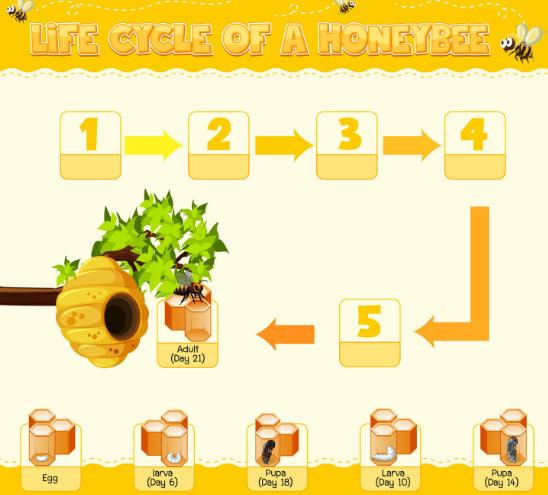
Life Cycle of Honey Bees (Egg → Larva → Pupa → Adult)
Honey bees follow one of the most organized and fascinating life cycles in the insect world. Their development is a combination of biology, chemistry, teamwork, and environmental intelligence. Unlike solitary insects, honey bees grow inside a highly structured colony where every stage is carefully supported and monitored by worker bees.
The complete life cycle of honey bees is known as Holometabolous metamorphosis, meaning they undergo four distinct stages:
Egg
Larva
Pupa
Adult
These stages differ in duration for queens, workers, and drones, but the progression remains the same.
🌼 1. Egg Stage – The Beginning of Life
Every honey bee begins life as a tiny white egg, smaller than a grain of rice.
⭐ Who lays the eggs?
Only the Queen Bee can lay fertilized eggs.
A healthy queen lays 1500–2000 eggs per day.
⭐ Where are eggs laid?
Eggs are laid inside hexagonal wax cells built by worker bees.
⭐ Structure of the egg
White, elongated shape
Attached vertically at the bottom of the cell
Nearly microscopic
⭐ Duration
3 days for all bee castes (queen, worker, drone)
During these three days, the egg slowly tilts from vertical to horizontal as development occurs.
🌼 2. Larva Stage – Feeding and Rapid Growth
On the 3rd day, the egg hatches into a larva, a small white worm-like creature with no legs or eyes.
This is the most important phase for determining the caste (Queen/Worker/Drone).
⭐ How are larvae fed?
Larvae are fed by nurse bees, which are young worker bees.
They produce food using their special glands:
Hypopharyngeal glands
Mandibular glands
⭐ Types of food given
| Caste | Food Type |
|---|---|
| Queen | Pure Royal Jelly (full diet) |
| Workers | Royal jelly (first 3 days) → Pollen + nectar |
| Drones | Pollen + nectar |
⭐ Growth rate
Larvae grow 1,500 times their size in just 5–6 days.
⭐ Duration
Queen: 5 days
Worker: 6 days
Drone: 7 days
⭐ Cell Capping
After the larva is fully grown, worker bees seal the cell using beeswax, turning it into a protective chamber for transformation.
🌼 3. Pupa Stage – The Transformation Chamber
Once the cell is sealed, the larva begins its miraculous transformation.
⭐ What happens inside?
The larva spins a cocoon
Legs, wings, antennæ form
Eyes develop (turning black last)
Internal organs restructure
Body segments become visible
This process is guided by hormones, especially ecdysone, responsible for insect metamorphosis.
⭐ Duration
Queen: 7–8 days
Worker: 12 days
Drone: 14 days
🌼 4. Adult Stage – Emergence and Role Assignment
When transformation is complete, the fully formed honey bee chews open the wax cap and emerges from the cell.
⭐ 4.1 Emergence Timing
| Caste | Total Days (Egg → Adult) |
|---|---|
| Queen Bee | 16 days |
| Worker Bee | 21 days |
| Drone Bee | 24 days |
This explains why:
Queen emerges fastest
Drones the slowest
⭐ 4.2 Newly Emerged Bee Appearance
Light, soft body
Grayish or pale coloration
Weak wings
Slightly trembling legs
Bees strengthen within hours and begin their roles.
🌼 5. Roles of Adult Bees (The Functional Phase)
Once bees emerge, each caste has a distinct purpose, forming the super-organized society of the hive.
⭐ A. Queen Bee – The Mother of the Colony
Duties:
Lay eggs (up to 2,000/day)
Control colony using pheromones
Mate during the mating flight
Maintain stability of the hive
Lifespan:
2–5 years, making her the longest-living bee.
⭐ B. Worker Bees – The Backbone of the Colony
All workers are females.
Their roles change based on age:
✔ 1–3 Days Old: Cleaners
Clean newly vacated cells
Maintain hygiene
✔ 4–6 Days Old: Nurse Bees
Feed larvae
Produce royal jelly
✔ 7–14 Days Old: Wax Makers + Builders
Produce beeswax
Build honeycombs
Seal honey cells
✔ 15–20 Days Old: Guards
Protect hive entrance
Attack intruders
✔ 20+ Days Old: Foragers
Collect nectar
Gather pollen
Bring water and propolis
Do waggle dances to share flower locations
Lifespan:
4–6 weeks (summer)
4–6 months (winter)
⭐ C. Drone Bees – The Males of the Colony
Duties:
Mate with virgin queen
Do not collect nectar
Do not produce honey
Need worker bees to feed them
After mating, drones die.
At the end of winter or scarcity, drones are expelled from the hive.
🌼 6. Caste Determination – How One Egg Becomes Queen or Worker
Interestingly:
All female eggs are genetically identical.
Then why is one a queen and others workers?
⭐ Difference = Diet
A queen larva is fed ONLY royal jelly
A worker larva is fed royal jelly for 3 days, then pollen mixture
Royal jelly triggers:
Faster growth
Full reproductive system
Larger body size
Pheromone glands
This diet-based caste determination is one of nature’s greatest wonders.
🌼 7. Colony-Level Life Cycle – The Hive as a “Superorganism”
Honey bees don’t just develop individually.
The entire colony itself has a “life cycle”:
Spring → Rapid egg laying
Summer → Maximum foraging + honey production
Autumn → Colony consolidation
Winter → Energy conservation
Next Spring → Swarming and expansion
This seasonal rhythm guides the survival of honey bees worldwide.
🌼 8. Summary Chart (Life Cycle at a Glance)
| Stage | Queen | Worker | Drone |
|---|---|---|---|
| Egg | 3 days | 3 days | 3 days |
| Larva | 5 days | 6 days | 7 days |
| Pupa | 7 days | 12 days | 14 days |
| Adult Emergence | 16 days | 21 days | 24 days |
Pollination - The Heart of Plant Reproduction
Pollination is one of the most essential natural processes on Earth, and honey bees are its most efficient agents. Without bees, most flowering plants would fail to reproduce, agricultural yields would drop dramatically, and ecosystems would collapse. Along with pollination, understanding the nutrition of honey bees explains how these insects maintain energy, produce honey, survive harsh seasons, and support colony functions.
🌼1. What is Pollination?
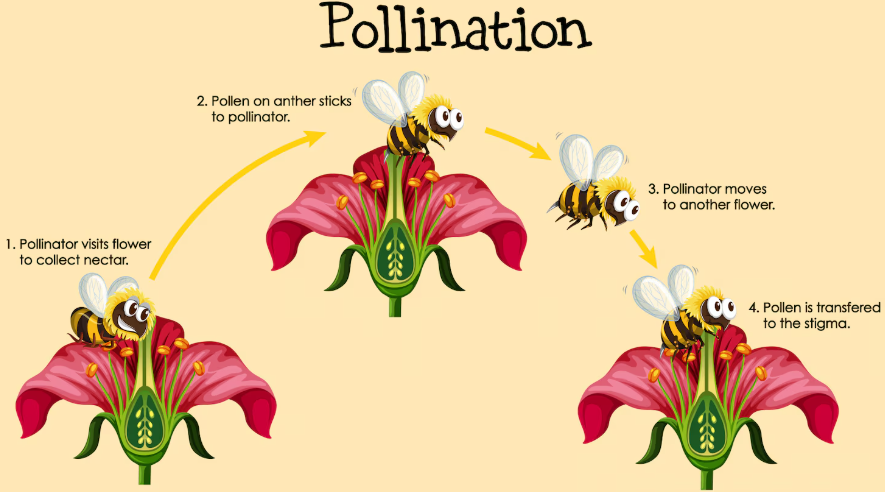
Pollination is the process of transferring pollen from the male part of a flower (anther) to the female part (stigma).
This allows plants to form:
Seeds
Fruits
Nuts
Grains
Honey bees perform cross-pollination, which boosts:
Fruit quality
Seed quantity
Plant survival
Genetic diversity
🌼 2. How Honey Bees Pollinate Flowers
Pollination by bees is both accidental and intentional.
⭐ Step-by-Step Pollination Process
Bee visits a flower to collect nectar.
Flowers attract bees using color, scent, and nectar availability.Pollen sticks to bee’s body hairs.
Bees have branched hairs designed to trap pollen grains.Bee moves to the next flower.
Pollen gets transferred to the new flower’s stigma.
Fertilization occurs → fruit/seed formation begins.
Thus, flower reproduction is directly linked to bee foraging.
🌼 3. Why Honey Bees Are the BEST Pollinators
✔ Buzzing Vibration – Helps release pollen
✔ Flower loyalty – Bees stick to one flower species per trip
✔ Large colony numbers – Thousands of bees working together
✔ Long foraging distances – 2–5 km daily
✔ Basket system – Pollen baskets on legs
Bees contribute to 35% of global food production and pollinate over 100 types of crops.
🌼 4. Types of Pollination Performed by Bees
⭐ 1. Biotic Pollination
Pollination involving a living organism – bees.
⭐ 2. Entomophily
Pollination done specifically by insects.
⭐ 3. Zoophily
Cross-pollination involving all animals, with bees being dominant.
⭐ 4. Melittophily
Pollination done exclusively by bees (special term).
Bees are the champions of melittophily.
🌼 5. Plants That Depend on Bees
Honey bees pollinate:
Fruits
Apples
Grapes
Mangoes
Strawberries
Watermelon
Citrus fruits
Vegetables
Cucumbers
Tomatoes
Beans
Pumpkins
Nuts
Almonds (90% dependent on bees)
Oil Crops
Sunflowers
Mustard
Without bees, many of these crops would reduce by 60–80%.
🌼 6. Flower–Bee Interaction (Mutualism)
Bees and flowers share a mutual relationship:
⭐ Bees get:
Nectar (carbohydrates)
Pollen (protein)
⭐ Flowers get:
Pollination
Reproduction boost
This natural partnership evolved over 100 million years.
Flowers attract bees using:
Bright colors (blue, yellow, UV patterns)
Sweet scents
Nectar guides (lines directing bees to nectar)
Nutrition of Honey Bees
Honey bees obtain all of their nutritional requirements from a diverse combination of pollen and nectar. Pollen is the only natural protein source for honey bees. Adult worker honey bees consume 3.4–4.3 mg of pollen per day to meet a dry matter requirement of 66–74% protein. The rearing of one larva requires 125-187.5 mg pollen or 25–37.5 mg protein for proper development. Dietary proteins are broken down into amino acids, ten of which are considered essential to honey bees: methionine, tryptophan, arginine, lysine, histidine, phenylalanine, isoleucine, threonine, leucine, and valine. Of these amino acids, honey bees require the highest concentrations of leucine, isoleucine, and valine; however, elevated concentrations of arginine and lysine are required for brood rearing. In addition to these amino acids, some B vitamins including biotin, folic acid, nicotinamide, riboflavin, thiamine, pantothenate, and most importantly, pyridoxine are required to rear larvae. Pyridoxine is the most prevalent B vitamin found in royal jelly and concentrations vary throughout the foraging season with the lowest concentrations found in May and the highest concentrations found in July and August. Honey bees lacking dietary pyridoxine were unable to rear brood.
🌼 1. Nutrition of Honey Bees – What Bees Eat
Honey bees need a balanced diet to maintain:
✔ Flight energy
✔ Wax production
✔ Brood feeding
✔ Queen health
✔ Colony temperature
Their nutrition comes from three main sources:
Nectar
Pollen
Water
🌼 2. Nectar – The Carbohydrate Source
Nectar is a sugary liquid produced by flowers.
⭐ Composition of Nectar
| Component | Percentage |
|---|---|
| Sugars (Fructose, Glucose, Sucrose) | 15–60% |
| Water | 20–85% |
| Minerals | Trace |
| Amino acids | Trace |
| Aroma chemicals | Very small amounts |
⭐ Purpose of Nectar for Bees
Provides energy for flying
Used to make honey
Feeds adult bees
Supports colony metabolism
Nectar = Bees’ fuel source
🌼 3. Pollen – The Protein Source
Pollen is essential for:
Brood development
Larvae growth
Queen health
Production of royal jelly
Worker bees’ muscle formation
⭐ Pollen Composition
| Nutrient | Percentage |
|---|---|
| Protein | 5–60% |
| Fats | 1–20% |
| Carbohydrates | 5–15% |
| Amino acids | 20+ types |
| Vitamins | A, B-complex, E, K |
| Minerals | Zinc, Iron, Calcium |
Pollen is stored in the hive as bee bread, fermented with enzymes and honey for long-term use.
🌼 4. Water – The Cooling & Dilution System
Bees use water for:
✔ Cooling the hive
✔ Mixing honey
✔ Feeding larvae
✔ Maintaining humidity (50–65%)
Worker bees collect tiny droplets from:
Ponds
Leaves
Moist soil
Dew
🌼 5. Enzymes Used in Bee Digestion
Honey bees use special enzymes produced in their glands:
⭐ Sucrase
Breaks down sucrose into glucose & fructose.
⭐ Invertase
Helps convert nectar into honey.
⭐ Glucose oxidase
Creates hydrogen peroxide → antibacterial action.
⭐ Diastase
Breaks down complex carbohydrates.
These enzymes ensure nectar becomes stable, nutritious honey.
🌼 6. How Bees Convert Nectar Into Honey (Nutrition → Storage)
Bees suck nectar using their proboscis.
Nectar goes into the honey stomach (not digestive stomach).
Enzymes mix with nectar.
Back in the hive, nectar is passed from bee to bee.
Moisture reduces from 70% → 18%.
Nectar thickens into honey.
Stored in honeycombs.
Sealed with wax to preserve it.
This honey becomes the primary winter food of the colony.
🌼 7. Seasonal Nutrition Needs of Honey Bees
⭐ Spring
Requires protein (pollen) → brood rearing begins.
⭐ Summer
High nectar → honey production peak.
⭐ Autumn
Bees store honey for winter.
⭐ Winter
Consumption of stored honey inside the hive.
Nutrition directly affects:
Colony health
Queen productivity
Survival rates
Honey quantity
🌼 8. Malnutrition Problems in Bees
If bees lack nutrition, colonies face:
Weak immune system
Low honey production
Fewer worker bees
Queen stops laying eggs
Colony collapse
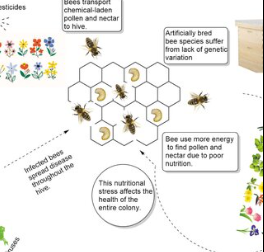
Modern farming decreases floral diversity, causing nutritional stress.
Beekeeping
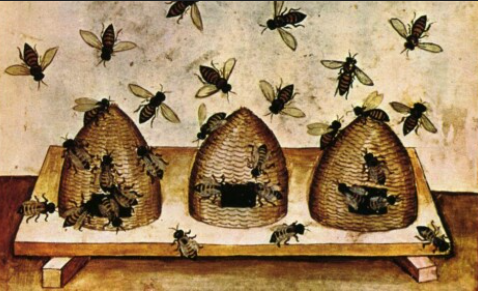
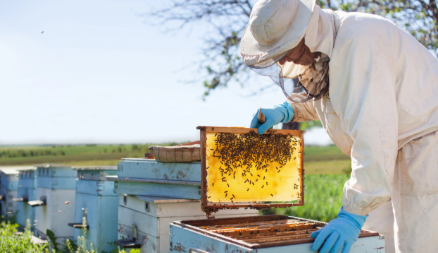
Beekeeping, also known as apiculture, is the organized practice of managing honey bee colonies to produce honey, beeswax, pollination services, and other valuable hive products. Humans have practiced beekeeping for thousands of years, evolving from simple honey gathering to modern scientific bee farming. Honey bees and humans share one of the oldest and most cooperative relationships in nature.
This section explores how beekeeping works, types of hives, tools, bee products, and their global economic significance.
🌼 1. What Is Beekeeping?
Beekeeping is the maintenance of bee colonies—usually in man-made hives—by a beekeeper (“apiarist”).
It includes:
Providing bees with a safe environment
Managing queen health
Encouraging honey production
Protecting colonies from pests
Harvesting honey and wax
Supporting pollination of crops
Beekeeping is both a science and an art, requiring knowledge of bee biology, seasons, habitats, and ecosystem interactions.
🌼 2. History of Beekeeping
⭐ Ancient Era
9000-year-old cave paintings in Spain show honey harvesting.
Egyptians kept bees in clay cylinders and transported hives along the Nile.
Vedic texts (India) describe honey medicinal uses since 2000 BCE.
⭐ Medieval to Modern Era
Wooden box hives were developed in Europe.
The invention of the moveable-frame hive by L.L. Langstroth (1852) revolutionized beekeeping.
Modern beekeeping is now industrialized in many countries.
Today, beekeeping ranges from hobby-level to large-scale commercial farms with thousands of colonies.
🌼 3. Types of Beehives Used in Beekeeping
⭐ 1. Langstroth Hive (Most Common Worldwide)
Moveable wooden frames
Vertical stacking boxes
Easy honey extraction
Allows colony inspection
Highly productive
This is the “standard hive” used in the USA, Europe, India, and Australia.
⭐ 2. Top-Bar Hive
Horizontal single box
No heavy lifting
More natural comb building
Good for small/eco-friendly beekeeping
⭐ 3. Warre Hive
Also called “People’s Hive”
Designed for minimal disturbance
Mimics natural tree-hollow habitat
Popular among organic beekeepers
⭐ 4. Traditional Indian Hives
Mud pots
Wall niches
Hollow logs (“log hives”)
Commonly used for Apis cerana and Apis dorsata in rural areas.
🌼 4. Essential Tools Used by Beekeepers
Bee Suit – Protection from stings
Smoker – Releases cool smoke that calms bees
Hive Tool – For opening hives and scraping wax
Bee Brush – Gently removes bees from frames
Queen Excluder – Prevents queen from entering honey boxes
Extractor Machine – Spins frames to extract honey
Beekeeping is safest when proper tools and training are used.
🌼 5. Bee Colony Management in Beekeeping
⭐ Maintaining Queen Health
A strong queen ensures a productive colony
Beekeepers replace old queens every 1–2 years
⭐ Swarm Control
Bees swarm when the colony is overcrowded.
Beekeepers prevent swarming by:
Adding boxes
Splitting colonies
Ensuring proper ventilation
⭐ Pest Management
Common threats include:
Varroa mites
Wax moths
Nosema disease
Using traps, medicines, and hygiene controls helps prevent colony loss.
🌼 6. Honey Production in Beekeeping
Honey is the main product of beekeeping.
⭐ Steps in Honey Production (Beekeeping Perspective)
Bees collect nectar
Convert nectar into honey inside hive
Beekeepers inspect frames
Frames filled with capped honey are removed
Wax cappings are cut off
Frames are placed in honey extractor
Honey is filtered and stored in jars
A strong colony produces 20–40 kg honey per year, depending on climate and flora.
Bee Products
🌼 1. Major Bee Products (Highly Valuable)
Honey bees create multiple products that humans use for food, medicine, and cosmetics.
⭐ 1. Honey
Energy-rich
Antibacterial
Never spoils
Used in medicine, skincare, and cooking
Contains:
Glucose
Fructose
Enzymes
Minerals
Vitamins
Antioxidants
⭐ 2. Beeswax
Used in:
Candles
Cosmetics
Furniture polish
Skin balms
Beeswax is made by worker bees using special wax glands.
⭐ 3. Pollen Pellets
Collected from flowers and eaten as a superfood.
Contains:
Proteins
Amino acids
Vitamins
Minerals
Used in health supplements.
⭐ 4. Royal Jelly
Special food for queen larvae.
Used in:
Anti-aging creams
Immunity supplements
Fertility products
⭐ 5. Propolis
A natural antibacterial glue made from tree resins.
Used for:
Medicines
Wound healing
Immune boosters
⭐ 6. Bee Venom
Used in apitherapy to treat:
Arthritis
Nerve pain
Skin disorders
🌼 2. Pollination Services – The Biggest Hidden Industry
In developed countries, pollination is more valuable than honey.
Farmers pay beekeepers to place hives in fields for crop pollination.
Example:
Almond farms in California rent millions of bee colonies annually.
Without bees, almonds cannot be produced.
Pollination creates:
Bigger fruits
Better quality
Higher yield
Faster plant growth
Economic value of bee pollination = $600 billion+ per year globally.
🌼 3. Economic Importance of Beekeeping
Beekeeping generates income through:
✔ Honey sales
✔ Beeswax
✔ Royal jelly
✔ Bee colonies
✔ Pollination contracts
✔ Beauty and pharmaceutical industries
✔ Organic farming support
Countries like:
India
China
USA
Turkey
Ethiopia
have huge beekeeping industries.
🌼 4. Human–Bee Interaction – A Mutual Relationship
🐝 Bees provide:
Honey
Pollination
Natural medicines
👤 Humans provide:
Protection
Hives
Disease control
Better habitats
This is one of Earth’s most successful cooperative partnerships.
Sexes And Castes
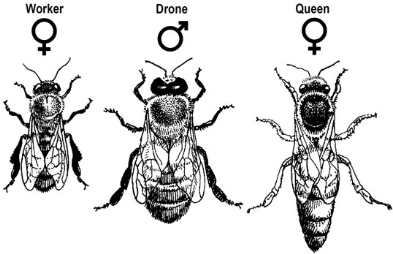
🌼 1. Sexes and Castes in Honey Bees
Honey bees exist in three biological groups, each with unique physical and behavioral characteristics.
⭐ 1. The Queen Bee — The Reproductive Female
The Queen is the only fully reproductive female in the colony.
🔹 Key Features:
Long abdomen
Well-developed ovaries
Smooth stinger
Releases pheromones to control colony
Lives 2–5 years
Lays up to 2,000 eggs/day in peak season
🔹 Roles:
Egg laying
Producing pheromones
Maintaining colony unity
The queen is the “heart” of the colony.
⭐ 2. Worker Bees — Non-Reproductive Females
Workers make up 98–99% of the colony.
🔹 Physical Features:
Small size
Barbed stinger
Specialized glands: wax, royal jelly, pheromone
🔹 Roles by age:
0–3 days → Clean cells
3–10 days → Feed larvae
10–16 days → Produce wax
16–20 days → Guard hive
20+ days → Forage for nectar, pollen, water
🔹 Worker bees maintain:
Hive cleanliness
Food storage
Thermoregulation
Defense
Honey production
They are the “workers” of the superorganism.
⭐ 3. Drone Bees — Males
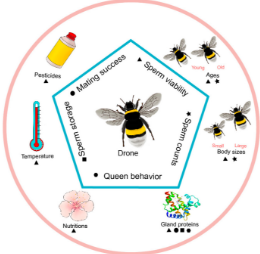
Drones exist only for mating.
🔹 Features:
Larger eyes
Bigger, heavier body
No stinger
Cannot collect nectar
Cannot feed themselves
🔹 Role:
Mate with a virgin queen
Die immediately after mating
During winter, drones are expelled from the hive to conserve food.
🌼 2. Genetics of Honey Bee Sex Determination
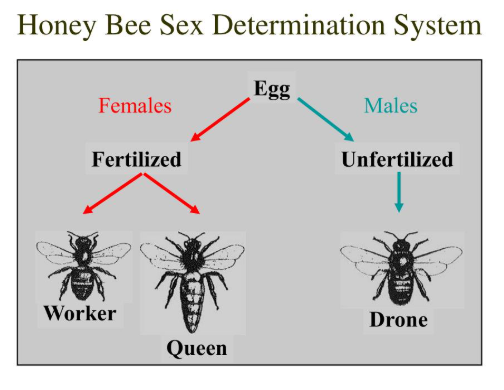
Honey bees use a unique system called Haplodiploidy.
⭐ What is Haplodiploidy?
| Bee Type | Chromosomes | Origin |
|---|---|---|
| Queen (Female) | Diploid (2n) | Fertilized egg |
| Worker (Female) | Diploid (2n) | Fertilized egg |
| Drone (Male) | Haploid (n) | Unfertilized egg |
⭐ Meaning:
Fertilized eggs → Female (Queen or Worker)
Unfertilized eggs → Male (Drone)
The Queen chooses whether to fertilize each egg, giving her total control over colony population.
🌼 3. How a Queen Develops (Caste Determination)
All female eggs are identical.
So how does one become a Queen?
✔ Diet determines caste.
⭐ Worker Diet
First 3 days → Royal jelly
After 3 days → “Bee bread” (pollen + nectar)
⭐ Queen Diet
Fed royal jelly for entire larval stage
This triggers:
Fully developed ovaries
Larger size
Longer lifespan
Strong pheromones
This is epigenetics, not genetics — meaning environment shapes the outcome.
Reproductive Timeline
🌼 1. Reproductive Timeline (Queen, Worker, Drone)
⭐ Timelines (Egg → Adult)
| Caste | Total Days (Egg → Adult) |
|---|---|
| Queen | 16 days |
| Worker | 21 days |
| Drone | 24 days |
The Queen develops fastest because the colony depends on her survival.
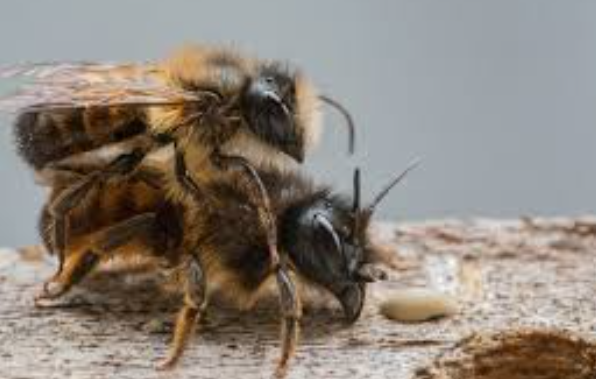
🌼 2. Mating Process — The “Nuptial Flight”
When a young queen emerges, she takes 1–3 mating flights.
⭐ Steps:
Virgin queen flies several km away
Drone congregation areas (DCAs) attract hundreds of drones
Queen mates with 10–20 drones mid-air
Semen is stored in the spermatheca
Queen returns permanently to hive
After mating:
Drones die
Queen never needs to mate again in her lifetime
She stores enough sperm to lay millions of eggs.
🌼 3. Worker Bee Reproduction (Emergency Case)
Workers normally cannot reproduce.
But if queen dies and no new queen develops:
✔ Some workers begin laying unfertilized eggs
✔ These produce ONLY drones
This leads to colony collapse if not corrected.
Reproductive Strategies
🌼 1. Reproductive Strategies of Honey Bees
Honey bees use advanced strategies to ensure long-term survival.
⭐ Strategy 1: Swarming
Swarming is how a colony reproduces itself.
Steps:
Queen lays new queen eggs
Old queen leaves hive with 40–70% worker bees
They form a temporary cluster
Scout bees search for new nest
Colony divides into two separate colonies
Swarming ensures natural population growth.
⭐ Strategy 2: Supersedure (Queen Replacement)
If the queen becomes:
Weak
Old
Low in pheromone
Laying fewer eggs
Workers create supersedure cells to raise a new queen.
The old queen may remain or be removed by workers.
⭐ Strategy 3: Emergency Queen Rearing
If queen dies unexpectedly:
Workers choose young larvae
Convert worker cell into queen cell
Feed ONLY royal jelly
New queen emerges
This saves the colony from extinction.
⭐ Strategy 4: Multiple Mating (Polyandry)
Queen mates with many drones.
Benefits:
Genetic diversity
Disease resistance
Better colony strength
Higher productivity
Honey bees have one of the highest polyandry rates in insects.
⭐ Strategy 5: Thermal Regulation for Brood Survival
Workers maintain brood temperature at 34–36°C.
They do this by:
Fanning wings
Clustering
Water evaporation
Muscle shivering
Temperature stability increases reproductive success.
🌼 2. Colony Expansion and Population Dynamics
Colony strength depends on:
Queen fertility
Food availability
Season
Worker population
⭐ Peak Colony Size:
60,000–80,000 bees (summer)
⭐ Winter Colony:
5,000–15,000 bees
⭐ Growth Cycle:
Spring → Rapid expansion
Summer → Maximum productivity
Autumn → Resource storage
Winter → Survival mode
Colony population follows environmental cycles.
🌼 3. Evolutionary Advantages of Honey Bee Reproduction
Honey bees evolved highly efficient reproductive systems that provide:
✔ Stable population
✔ Long-term survival
✔ Genetic strength
✔ Balanced sex ratio
✔ Colony-level immortality
Individual bees die, but the colony lives for years, acting as a superorganism.
🌼 4. Summary
Honey bees have:
A caste-based society
Haplodiploid sex determination
Queen-centered reproduction
Drone-only mating purpose
Worker-controlled colony survival
Complex reproductive strategies
Swarming and supersedure systems
Temperature-controlled brood environment
This section reflects the biological brilliance of honey bees and why their reproductive system is considered one of nature’s greatest designs.
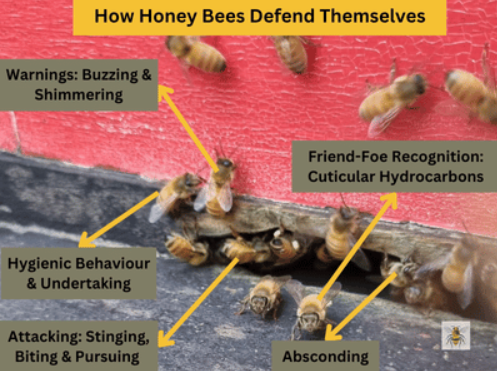
Defense
🌼 Defense Mechanisms of Honey Bees
Honey bees are highly protective of their colony because:
Their hive contains food (honey)
Their queen is the life source
Their young larvae are the future workers
Their colony is a superorganism that must survive
Bees use multiple levels of defense, both individual and collective.
⭐ A. Physical Defense (Sting Mechanism)
Worker bees have a barbed stinger, designed to embed into the skin of predators.
When a worker stings a mammal:
The barbed stinger gets stuck
The bee’s abdomen tears
The bee dies shortly after
This self-sacrifice shows how deeply bees prioritize colony safety.
🔹 Queen’s Stinger
Smooth
Can sting multiple times
Used only against rival queens
🔹 Drone Bees
No stinger at all
⭐ B. Chemical Defense (Alarm Pheromones)
When one bee stings, she releases alarm pheromones.
These are chemicals that:
Alert nearby bees
Trigger defensive behavior
Guide more bees to the threat
Smell like banana essence
Within seconds, dozens of bees may attack an intruder.
⭐ C. Heat-Balling Defense (Against Small Predators)
Honey bees can kill small enemies like wasps and hornets by forming a “heat ball.”
Steps:
Dozens of bees surround the intruder
They vibrate wing muscles
Temperature reaches 45°C
Predator overheats and dies
This cooperative defense shows incredible teamwork.
⭐ D. Guard Bees (Hive Security)
Certain worker bees specialize as guards.
They:
Patrol the hive entrance
Smell incoming bees
Attack foreign bees
Fight robber bees
Keep pests out
Guard bees are the colony’s frontline defenders.
Competition
🌼 Competition in Honey Bees
Honey bees face competition from:
Other colonies
Wild bees
Wasps
Hornets
Humans
Environmental conditions
Competition determines which colonies thrive.
⭐ A. Robbing (Colony vs Colony Competition)
When food is scarce:
Strong colonies attack weaker colonies
They steal honey
Kill defending bees
Destroy brood
This is called robbing, and it can collapse an entire hive.
⭐ B. Interspecies Competition
Honey bees compete with:
🔹 Bumble bees
For flower resources.
🔹 Carpenter bees
For nesting space.
🔹 Hornets
For colony invasion.
🔹 Wasps
For honey theft.
Some hornet species (e.g., Vespa mandarinia, the “Murder Hornet”) can kill thousands of honey bees in minutes.
⭐ C. Environmental Competition
Honey bees compete with nature:
Limited flowers in winter
Drought reduces nectar
Heavy rains block foraging
Heat waves stress colonies
Only strong colonies survive extreme environments.
Communication
🌼 Communication – The Waggle Dance (A Scientific Marvel)
Honey bees have the most advanced communication system among insects.
Their famous “Waggle Dance” is a language used to share information about:
Flower location
Distance
Direction
Quality of nectar
Danger
This communication is so precise that it rivals human-made GPS systems.
⭐ A. Discovery of Waggle Dance
Discovered by Karl von Frisch, who won the Nobel Prize for proving that bees communicate symbolically.
⭐ B. How the Waggle Dance Works
The forager bee returns to the hive and dances on the comb.
The dance has two main parts:
Waggle Run
Return Loop (Figure-eight pattern)
⭐ C. Information Encoded in the Dance
🔹 Direction
The angle of the waggle run relative to vertical indicates the direction of flowers compared to the sun.
🔹 Distance
The length of the waggle run shows how far the flowers are.
Longer waggles → farther
Shorter waggles → closer
🔹 Quality of Nectar
Faster dancing = higher quality source.
🔹 Quantity of Flowers
More repetitions = more abundant field.
⭐ D. Vibrations & Sound Signals
Bees use:
Wing vibrations
Buzz patterns
Antenna touches
Body movements
This allows communication even in darkness inside the hive.
Symbolism
🌼 Symbolism of Honey Bees (Cultural & Spiritual Meaning)
For thousands of years, honey bees have inspired:
Religion
Mythology
Medicine
Art
Philosophy
Leadership principles
They symbolize both nature and spirituality.
⭐ A. Ancient Egypt
Bees symbolized royalty
Pharaohs used bee symbols for power
Honey was used in healing & embalming
⭐ B. Greek Civilization
The word “Melissa” means honey bee
Bees connected to Artemis, goddess of nature
Honey considered “food of the gods”
⭐ C. Hindu Tradition & Ayurveda
Honey (Madhu) is one of the five elixirs (Panchamrit)
Bees represent purity, harmony, and natural balance
⭐ D. Christianity
Bees symbolize virginity, discipline, and resurrection
Monasteries used beeswax for sacred candles
⭐ E. Celtic & European Culture
Bees represent community, prosperity, and diligence
⭐ F. Modern Symbolism
Today bees symbolize:
Environmental protection
Sustainability
Clean agriculture
Teamwork & leadership
Climate change awareness
Bees are nature’s ambassadors, reminding us that small creatures sustain the big world.
Defense, Competition, Communication & Symbolism of Final Conclusion
Honey bees are among the most extraordinary creatures on Earth.
Their biology, intelligence, teamwork, and environmental importance make them essential to life. They are not just honey producers; they are the heartbeat of ecosystems, responsible for pollinating one-third of the food humans eat.
Their caste system is a masterpiece of evolution:
The Queen maintains fertility and unity
Workers run the entire hive with discipline
Drones preserve genetic diversity
Their reproduction system—mating flights, swarming, supersedure—ensures colony survival for generations.
The life cycle of honey bees is a marvel: from egg to larva to pupa to adult, regulated entirely by worker supervision and nutrition.
Honey bees’ communication through the waggle dance shows their cognitive intelligence.
Their defense mechanisms—from alarm pheromones to heat-balling attacks—demonstrate advanced social cooperation.
In competition, honey bees survive against predators, environmental fluctuations, and rival colonies.
Humans have depended on bees for:
Agriculture
Medicine
Honey & wax
Pollination
Ecology
The symbolic value of bees spans continents. From Egypt to India to Europe, they represent purity, hard work, prosperity, rebirth, and harmony.
Honey bees are fragile giants of nature.
If bees disappear, ecosystems will break, crops will fail, and human life will face unimaginable challenges.
Therefore, understanding honey bees is not only scientific—it is a responsibility.
Protecting them ensures:
Biodiversity
Food security
Natural balance
Human survival
Honey bees are not just insects—they are caretakers of the Earth.
Their importance is immeasurable, their intelligence remarkable, and their survival essential for the future of all life.